

If you’re learning to play the guitar, you’ve likely come across the term “capo” in your lessons or favourite song tutorials. A capo is a small but powerful tool that can unlock new sounds and make playing your favourite songs easier.
In this post, we’ll discuss what a capo is, how it works, and offer some helpful tips for using it effectively in your music.
Table of contents
What Is a Capo?
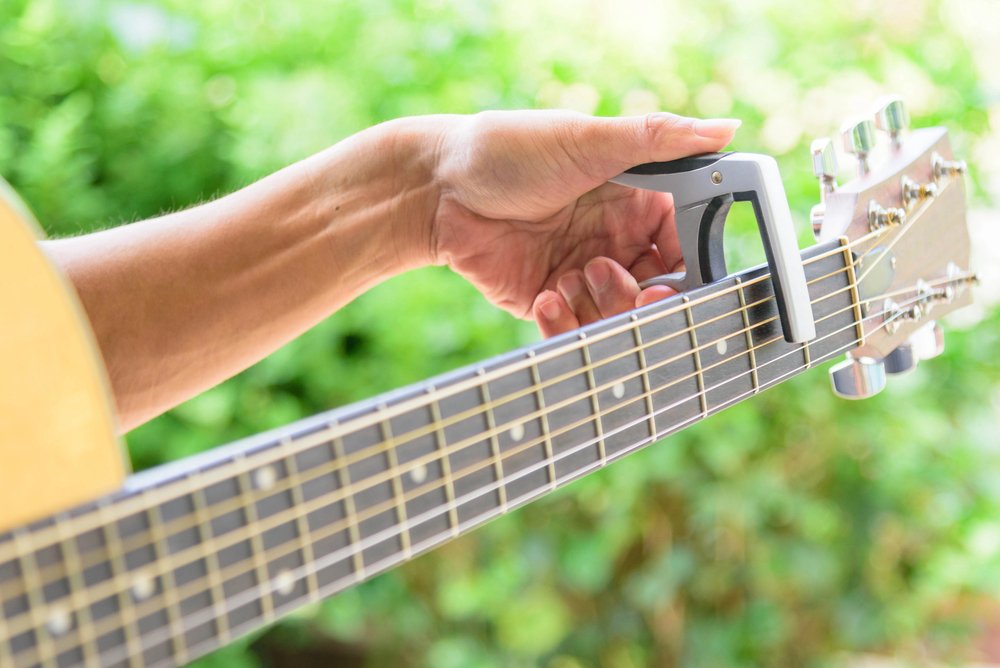
A capo (short for “capotasto,” which means “head of the fretboard” in Italian) is a clamp-like device that is placed on the neck of a guitar. Its purpose is to shorten the playable length of the strings, effectively raising the pitch of the guitar without needing to adjust the tuning.
By using a capo, you can:
- Make difficult chords easier to play by using familiar open chord shapes.
- Experiment with new sounds and textures in your music.
- Change the key of a song to match your vocal range when singing and playing guitar.
Capos are commonly used in many styles of music, including pop, rock, country, and folk.

How Does a Capo Work?
A capo works by pressing down the strings of a guitar at a specific fret. This changes the pitch of the open strings, based on which fret was selected for the capo.
For example:
- Without a capo, the open strings of a guitar play the notes E, A, D, G, B, and E.
- Placing a capo on the 2nd fret raises the pitch of the strings by a whole step, so the open strings now play F#, B, E, A, C#, and F#.
This allows you to play the same chord shapes you already know, but they will now sound higher in pitch. The following chart shows how common open chords change in pitch when using a capo at a particular fret. For example:
- G becomes A with a capo on the 2nd fret.
- C becomes D with a capo on the 2nd fret.

How to Use a Capo
Using a capo is simple! Follow these steps to get started:
- Choose the Right Position:
Decide which fret you want to place the capo on. This depends on the key of the song you’re playing. For example, if you want to play a song in the key of E using chord shapes from the key of C, place the capo on the 4th fret. - Attach the Capo Securely:
Open the capo and place it just behind the desired fret (closer to the fret wire, but not on top of it). Make sure it presses down all the strings evenly to avoid buzzing or muted notes. - Retune if Necessary:
Sometimes, using a capo can slightly affect the tuning of your guitar. Check your tuning after attaching the capo and make small adjustments if needed. - Play Your Chords:
Use the chord shapes you already know. For example, a G chord shape with a capo on the 2nd fret will sound as an A chord.
Tips for Using a Capo
- Choose the Right Type of Capo:
There are several styles of capos, including trigger, screw, and strap capos. Experiment to find one that feels comfortable and secure on your guitar. - Practice Transposing:
Get familiar with how the capo changes the key of your chords. This will help you understand music theory and adapt to different songs easily. - Experiment Creatively:
A capo isn’t just for changing keys—it can also create interesting sounds. Try placing the capo at unusual frets or only covering certain strings to discover new musical possibilities.
Using a Capo as a Learning Tool
Playing chords can be a challenge for many beginner guitarists. The strings may feel hard to press down, and the wide spacing between frets can make forming certain chords tricky, especially for smaller hands. This is where a capo becomes an invaluable learning tool.
When you place a capo higher up on the neck of the guitar—closer to the 5th or 7th fret—the strings become easier to press. Additionally, the distance between the frets becomes smaller as you move up the neck, which reduces the stretch needed for forming chords. This makes playing complex chord shapes much more accessible for beginners.
Using a capo in this way allows beginners to focus on developing muscle memory without the added frustration of difficult stretches or muted notes. As their skills and confidence grow, they can gradually move the capo closer to the nut or play without it entirely.

Popular Songs That Use a Capo
Many popular songs use a capo to achieve their unique sound. Here are a few examples to try:
- “Wonderwall” by Oasis – Capo on 2nd fret
- “Here Comes the Sun” by The Beatles – Capo on 7th fret
- “Fast Car” by Tracy Chapman – Capo on 2nd fret
- “The A Team” & “Thinking Out Loud” by Ed Sheeran – Capo on 2nd fret
- “Hotel California” by Eagles – Capo on 7th fret (for the 12-string guitar)
Conclusion
A capo is a versatile tool that can enhance your guitar playing, whether you’re a beginner or an experienced musician. By understanding how it works and practicing with it, you’ll gain confidence in tackling songs in different keys and exploring new sonic possibilities.
So grab a capo, experiment with your favourite songs, and see how this simple accessory can elevate your playing to the next level!


